Editorial disclosure: This page contains no affiliate links; we do not earn commissions from its links. We explain manufacturers’ material descriptions and clearly identify information we could not verify.
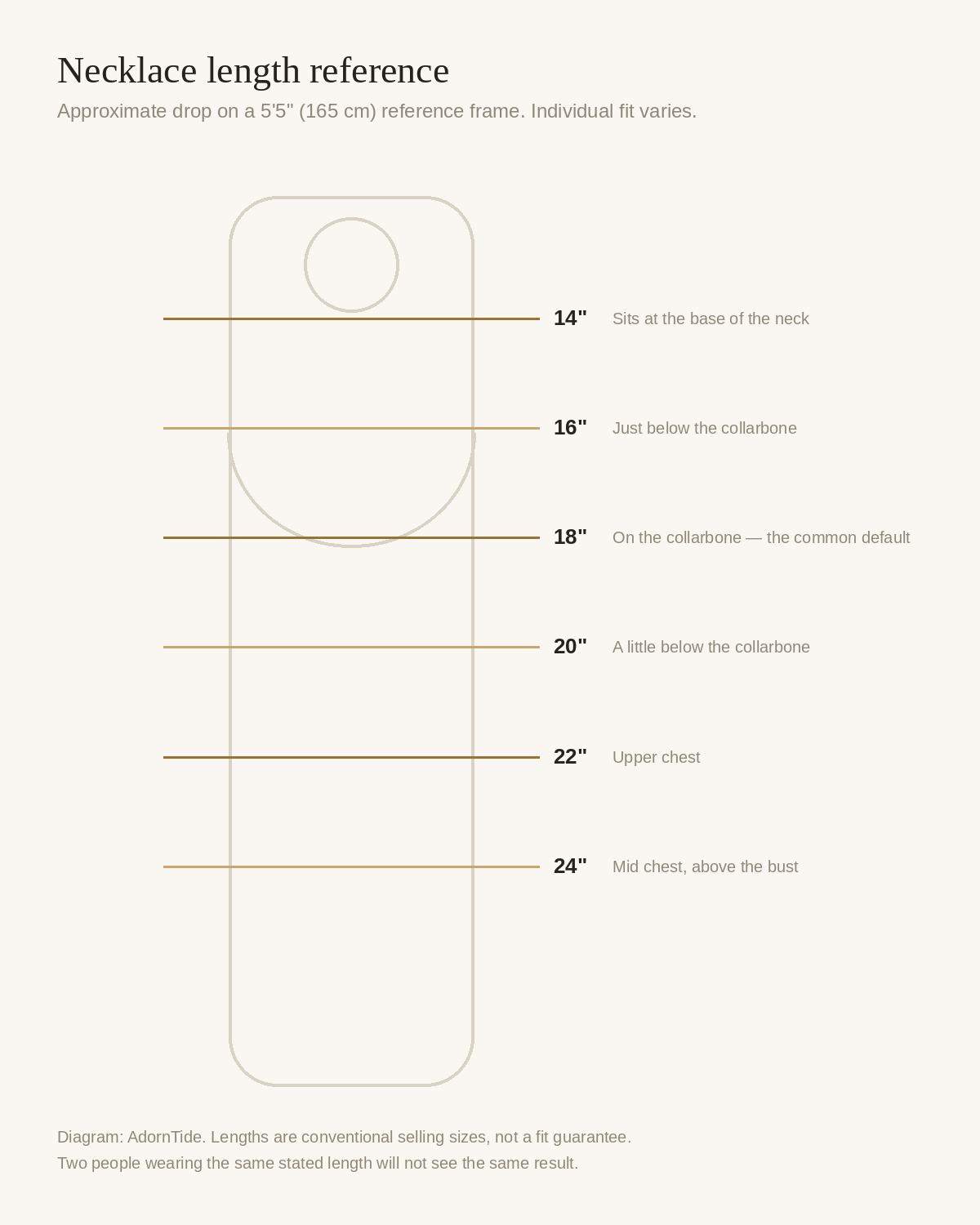
Necklace length is the one choice that decides whether a chain sits where you want it. The short answer: 14″–16″ sits at or just below the base of the neck, 18″ lands on the collarbone, 20″–22″ falls to the upper chest, and 24″ reaches the mid chest. Those are the conventional selling sizes — they describe the chain, not the person wearing it.
That last point matters more than the chart. Two people wearing the same stated length will not see the same result, because neck circumference, shoulder width, torso length and posture all move where a chain comes to rest.
What each length usually looks like
These are the sizes most listings actually sell, and roughly where each one tends to sit on an average adult frame. Use them as a starting point for a decision, not as a promise.
- 14 inches — a collar-length chain, sitting at the base of the neck. Uncommon outside choker styles.
- 16 inches — just below the base of the neck. Reads as a close, deliberate fit.
- 18 inches — the most common default. Typically rests on or just above the collarbone.
- 20 inches — a little below the collarbone. Often the first length that reads as a “drop”.
- 22 inches — upper chest. Common for pendants that should sit clear of a neckline.
- 24 inches — mid chest, generally above the bust. The longest everyday length most brands stock.
How the same length reads with different necklines
The neckline changes the visual result more than the number does, because it sets the line the chain works against.
- Open collar — a vertical gap. One chain sits in the gap rather than competing with it; two chains can read as one if the lengths are too close together.
- Crew neck — a fixed horizontal line. Two chains at clearly different lengths stay readable against it; a single chain can disappear.
- V-neck — the chain and the neckline point the same way, so a pendant at the base of the V is the obvious placement.
- Boat or wide neck — a long horizontal line. A short chain can look stranded; longer lengths sit better.
- High or turtleneck — worn over the fabric, the chain needs extra length to clear it.
Why fit varies between people
A stated length is the length of the chain, measured end to end, usually excluding the clasp. Where that chain comes to rest depends on the wearer. Two people can be the same height and still see the same chain finish in visibly different places, because neck circumference, shoulder width and torso length are independent of height.
This is why a length chart is a starting point and a mirror is the actual test. No chart can tell you where an 18-inch chain will sit on you specifically.
How to measure a chain you already own
If you own a chain that sits how you want, measure it rather than guessing from a chart:
- Lay the chain flat and unclasped, without stretching it.
- Measure from one end of the chain to the other, excluding the clasp.
- Measure the extender separately if it has one — that is usable range, not base length.
- If you are judging a pendant, measure to the pendant base too, since the drop adds to the total.
That measured figure is what to compare against a listing. A listing’s stated length usually describes the chain only, so a pendant or extender changes the finished drop even when the number is accurate.
Layering lengths that stay separate
Layering works when the chains read as deliberately spaced rather than bunched. A useful starting point is a gap of roughly two inches between each chain, which keeps them apart without looking disconnected.
Practical combinations worth trying: 16″ with 18″, 18″ with 20″, or 18″ with 22″. Two chains of the same length will tangle and read as one line. If you want three layers, widen the gaps rather than adding a third chain in the same range.
Common purchase mistakes
- Buying an 18-inch chain because it is the default, without checking where it actually lands.
- Assuming a stated length includes the clasp, the pendant or the extender. It usually does not.
- Layering two chains of the same length and expecting two visible layers.
- Treating a length chart as a fit guarantee rather than a description of the chain.
- Choosing a length for a neckline that the chain will never sit against, such as a chain worn over a high knit.
The short version
Pick the length by where you want the chain to finish, not by the number alone. Measure a chain you already like, then match that figure. Expect two people to see different results from the same stated length — that is normal, not a fault in the chain.
Related reading
- 4 Everyday Necklace Styling Ideas — the looks these lengths are built for.
- How to Read a Jewelry Listing Before You Buy — what a listing does and does not tell you about length.
- Gold-Tone Jewelry: What to Check Before You Buy — materials and coatings behind the finish.